
Tawang Grand Monastery
"Gaden Namgyal Lhatse - India's largest Buddhist monastery"
Tawang Grand Monastery (Gaden Namgyal Lhatse) is a 17th-century Gelugpa Buddhist monastery located in Tawang town, Tawang District, Arunachal Pradesh, India, at an elevation of 3,000 meters (10,000 feet). The second-largest Buddhist monastery in the world and the largest in India, it serves as the spiritual heart of the Monpa people and was founded in 1680 by Merak Lama Lodre Gyatso.
Sensory Opening: The Dawn Call of the Dungchen
Step into the stone courtyard of the monastery at 05:30 AM, and the silence of the Himalayas is broken by the deep, mournful drone of dungchen—ten-foot-long brass horns played by young monks from the assembly hall roof. The crisp, near-freezing mountain air carries the scent of burning juniper incense (sang) and salty butter tea from the communal kitchens. As the morning mist lifts, the whitewashed stone walls and bright yellow roofs of the monastic complex gleam under the first rays of the sun, framed by hundreds of colorful prayer flags fluttering over the Tawang Chu valley.
History & Cultural Significance: The Chosen Site
Founded in 1680–1681 under the guidance of the 5th Dalai Lama, Ngawang Lobsang Gyatso, the monastery was named Gaden Namgyal Lhatse, meaning "heavenly paradise in a clear night." The popular name "Tawang," meaning "Chosen by the Horse," stems from a legend about its founder, Merak Lama Lodre Gyatso. Frustrated by his inability to find a suitable site, he prayed in a cave, and upon emerging, found that his horse had wandered to the top of a scenic ridge. Taking this as a divine sign, he built the monastery there, which quickly grew into the political and cultural center of the Monpa people.
The monastery has been a crucial refuge throughout modern history, most notably in 1959 when the 14th Dalai Lama fled Tibet according to official historical records and stayed here for several days before continuing his journey to India. It also stood as a symbol of local resilience during the Sino-Indian War of 1962, surviving undamaged despite heavy fighting in the region. Rated 4.8/5 on Google Maps with over 2,500 reviews, it continues to attract thousands of pilgrims and travelers annually as a living monument of Buddhist heritage.
Spiritual & Religious Context: The Gelugpa Core
As a major seat of the Gelugpa (Yellow Hat) school of Tibetan Buddhism, Tawang Monastery houses around 450 resident monks who follow a rigorous daily schedule of prayer, debate, and philosophical study. The center of daily worship is the Dukhang (Assembly Hall), where visitors can witness the morning prayers starting at 05:30 AM or the lively afternoon debates where monks clap their hands to emphasize points of Buddhist logic. The monastery's spiritual calendar is highlighted by the annual Torgya festival in January, where monks perform sacred Cham dances wearing elaborate masks to dispel evil spirits and pray for prosperity.
Architecture & Design: A Fortified Citadel
The monastery is built like a dzong (traditional Tibetan fortress) covering an area of 135 square meters and enclosed by a 925-foot-long stone wall to protect it from historical raids. Pilgrims enter through the Kakaling, a colorful gateway decorated with murals of protective deities and intricate mandalas painted on the wooden ceiling. The crowning jewel of the complex is the three-story Dukhang, which houses a colossal, 26-foot-tall gilded Lord Buddha Shakyamuni statue seated on a lotus throne, flanked by thangkas (sacred scroll paintings) embroidered with crushed semi-precious stone pigments.
Behind the assembly hall, the Par Khang (monastery library) acts as a repository of ancient wisdom, housing rare manuscripts of the Kangyur (teachings of Buddha) and Tengyur (commentaries). These sacred texts, wrapped in fine silk and stored on floor-to-ceiling wooden racks, include volumes written in gold and silver ink. The adjacent museum displays personal artifacts belonging to the 6th Dalai Lama, Tsangyang Gyatso, who was born in nearby Urgelling.
When Is the Best Time to Visit Tawang Monastery?
- Spring (March to May): Moderate daytime temperatures ranging from 10°C to 18°C make this an ideal time for sightseeing. The surrounding valleys are filled with blooming rhododendrons and orchids.
- Summer & Monsoon (June to September): High rainfall brings heavy fog and frequent landslides along the mountain highways, which can cause significant travel delays.
- Autumn (October to November): Offering the best visibility, with crisp, clear skies and temperatures between 5°C and 15°C. This is the prime season for photography of the snow-capped peak backdrops.
- Winter (December to February): Brutally cold with nighttime temperatures plunging to −10°C, and occasional heavy snowfall. However, it is the best time to experience the Torgya festival in January without the crowds.
Photography Guide
- The Dukhang Courtyard: Best photographed in the early morning around 06:00 AM when soft sunlight hits the yellow-roofed facade, casting dramatic shadows.
- The Kakaling Gate Ceiling: Use a wide-angle lens with low-light settings to capture the vibrant mandalas painted on the underside of the entry arch.
- Panoramic Viewpoint: Walk 1.5 kilometers south to the Tawang War Memorial ridge to capture a postcard-perfect view of the monastery perched on its cliffs.
Nearby Attractions
- Urgelling Monastery: Located 5 kilometers south (15 minutes by road), this is the birthplace of the 6th Dalai Lama and offers a quiet, contemplative atmosphere.
- Tawang War Memorial: Situated 2 kilometers away (10 minutes by road), this monument pays tribute to the soldiers of the 1962 war.
- Panga Teng Tso (PT Tso): A scenic glacial lake located 18 kilometers north (45 minutes by road) on the highway leading toward Bum La Pass.
Getting There
The monastery is located 2 kilometers from the center of Tawang town and can be easily reached via local taxi or a 20-minute uphill walk. To reach Tawang, travelers must journey along the Bhalukpong-Tawang highway (NH-13), passing through Bomdila and crossing the high-altitude Sela Pass. The road journey from the nearest airport at Tezpur takes about 12 hours (320 kilometers), while the drive from Guwahati takes 14 to 15 hours. To explore these scenic routes, travelers usually consult a Tawang destination guide and include the monastery in a comprehensive 7-day tour package.
Insider Tips
- Attend the morning prayer session: Be inside the assembly hall by 5:30 AM to witness the morning prayers, chanting, and dungchen playing.
- Explore the onsite museum: Spend time at the museum first to gain critical historical context on the monastery's defense history against Mongol raids.
- Walk clockwise: Always walk in a clockwise direction when circumambulating any shrine, prayer wheel, or stupa.

7-Day Tawang Tour Package from Guwahati: Dirang, Sangti & Shergaon
Mountains & Monpas: A Curated Himalayan Journey
Visitor & Booking Protocol
Permit & Entry Check
State permit / ILP verification required at highway checkpost before arrival.
Tickets & Cash Protocol
Entry desk is managed on-site. Carry small cash denominations (₹20, ₹50, ₹100) for entry and parking.
Certified Guide Desk
Authorized village community guides can be hired at the entry registration desk. Certified guide rates range between ₹800–₹1,500 depending on circuit and trail duration.
Timing & Departure Cutoff
Arrive during early morning hours (08:00–10:30 AM). Mountain trails, caves, and viewpoints generally stop inbound entry by 15:30 to ensure safe return before mountain dark.
Safety & Rules
- • Remove footwear: Take off shoes before entering the Dukhang or any individual shrine room.
- • No photography inside shrines: Do not take photos or videos of the statues, scriptures, or altars inside the prayer halls.
- • Respect private zones: Do not enter the residential huts (Sha) or school classrooms without invitation.
Frequently Asked Questions
More Places to Visit in Tawang
Handpicked stops our drivers pass every week.

Bum La Pass
The historic and rugged high-altitude frontier connecting India and Tibet
4633m ASL
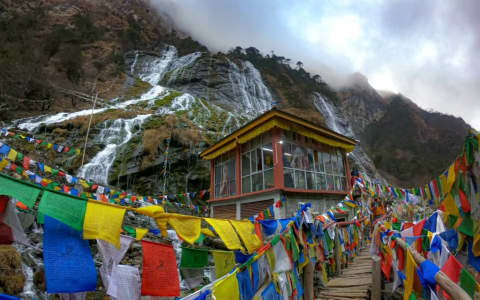
Chumi Gyatse (Holy Water Falls)
108 Sacred Cascades on the Edge of the Tawang Frontier
3505m ASL

Sela Pass
Dramatic high-altitude mountain pass and the sacred gateway to Tawang
4170m ASL

Nuranang Falls
A spectacular 100-meter drop waterfall famously known as Jang Falls or Madhuri Falls
1828m ASL

Sangetsar Tso (Madhuri Lake)
The hauntingly beautiful high-altitude lake of frozen pine trunks at 12,165 feet
3708m ASL

Tawang War Memorial
Namgyal Chorten - Tribute to the brave martyrs of the 1962 Sino-Indian War
3000m ASL
Best Time to Visit
Best time of day: Morning
Visitor Specs
Respect prayer hours and study times.
How to Reach
Altitude & Terrain
3,000m (10,000ft)
7-Day Tawang Tour Package from Guwahati: Dirang, Sangti & Shergaon
Mountains & Monpas: A Curated Himalayan Journey
Location
Lng: 91.857500
Plan Your Trip to Tawang with Nezo
Combine Tawang Grand Monastery with living tribal heritage, scenic mountain vistas, and handpicked local stays on a private guided journey.