
Riwai Living Root Bridge
"Living Botanical Architecture"
Single Decker Living Root Bridge (Jingkieng Jri Riwai) is an ancient bio-engineered pedestrian bridge located in Riwai village near Mawlynnong, East Khasi Hills District, Meghalaya, at 500 meters above sea level. Spanning 13 meters across the Wah Thyllong stream, it is the most accessible living root bridge in Meghalaya and Northeast India.
Cool, humid river air rises off the clear currents of Wah Thyllong, carrying the sharp scent of crushed wet moss and damp sandstone boulders. Beneath your boots, the thick aerial roots of the Riwai Living Root Bridge feel surprisingly firm, smooth from decades of footsteps and bound tightly around river pebbles. Water murmurs steadily across the shallow granite bed below, punctuated only by cicadas echoing through the dense betel nut canopy.
Botanical Engineering & Living Root Architecture
Unlike conventional wooden or concrete bridges that deteriorate under Meghalaya's extreme annual rainfall, living root bridges grow stronger as they age. The Khasi people of the southern slopes (War Khasi) developed this sustainable bio-engineering technique centuries ago by harnessing the aerial roots of the Ficus elastica (Indian rubber fig) tree.
To construct the bridge, local builders placed hollowed-out trunks of areca nut palms (Areca catechu) or bamboo across the river chasm. Young, pliable aerial rootlets sprouting from the parent tree were threaded through these guide conduits to protect them from weathering while steering their growth toward the opposite bank. Upon reaching the far side, the roots anchored themselves firmly into the riverbank soil. Over decades, through a biological process known as anastomosis or inosculation, touching root fibers naturally grafted and fused together under mechanical tension, transforming individual strands into an interwoven, load-bearing botanical truss.
The Riwai bridge spans 13 meters across the primary river channel, while its complex root superstructure and anchor cables extend across 25 to 30 meters of boulder-strewn terrain. The central parent fig tree is estimated to be between 250 and 300 years old, with the bridge itself cultivated roughly 150 to 180 years ago. As seasonal monsoons deposit nutrients and the tree matures, secondary root cambium expands, continually reinforcing the structural integrity of the walkway.
The Trail Down from Riwai
Reaching the bridge requires a gentle 300-meter descent starting from the designated village parking area in Riwai. The path winds down roughly 80 to 120 stone steps interspersed with cobblestone ramps, flanked by local bamboo railings and tidy village homesteads. Most visitors reach the riverbed within 10 to 15 minutes of relaxed walking.
This modest walk contrasts sharply with the arduous expedition required to reach the Double Decker Root Bridge in Nongriat near Cherrapunji, which demands descending more than 3,500 vertical steps and climbing back up. Because of its manageable gradient, Riwai is widely regarded as the premier root bridge destination for families traveling with young children or active older adults. Note that the stone stair risers, exposed surface roots, and damp boulders make the trail unsuitable for wheelchairs.
The stone pavers along the trail can become slick from morning dew and forest mist. Wear footwear with dependable rubber traction rather than smooth leather soles, flip-flops, or heeled shoes.
Cultural Heritage & Village Stewardship
Locally known in the Khasi language as Jingkieng Jri Riwai (Jingkieng meaning bridge, Jri meaning rubber tree), the crossing historically served as an indispensable trade artery. It connected remote hamlets like Riwai and Nohwet to ancient mountain trails leading down to the trading plains of Sylhet.
A common point of confusion among first-time visitors is the word "Jingmaham," often mistakenly cited on travel forums as the bridge's formal name. In Khasi, Jingmaham simply translates to "Warning" or "Caution." It appears in bold red letters on trailside safety signboards instructing travelers on weight limits and river etiquette.
Today, the bridge is conserved and operated under the strict collective custody of the Riwai Village Ecotourism Committee. Modest visitor entry and parking fees flow directly back into village welfare: financing community sanitation, maintaining the paved footpath, supporting village schools, and funding botanical maintenance for the living roots. Because the Wah Thyllong stream serves as an essential downstream water source for neighboring communities, washing with commercial soap or shampoo in the river is strictly prohibited.
When Is the Best Time to Visit?
The ideal travel window to visit Riwai spans from October to May, when Northeast India transitions into dry, pleasant weather. Between November and February, daytime temperatures hover comfortably between 15°C and 24°C, the trail stays completely dry, and the waters of Wah Thyllong turn crystalline over pale river boulders.
The monsoon months from June to September offer a completely different visual encounter. Wah Thyllong swells into a foaming river torrent, demonstrating the true mechanical purpose of the bridge as aerial roots hold firm against violent floodwaters. The surrounding subtropical rainforest turns deep emerald, though the stone steps become wet and require deliberate, cautious footing.
Aim to arrive at the trailhead between 7:30 AM and 9:00 AM. Early morning hours let you walk the bridge deck quietly in cool shade before daytime excursion vehicles arrive from Shillong. Alternatively, visiting between 3:30 PM and 4:30 PM provides mellow late afternoon light.
On Sundays, the bridge and ticket gate remain open to travelers. However, the residents of Riwai and surrounding villages observe morning church services, meaning local handicraft and food stalls remain closed until 1:00 PM. Furthermore, neighboring Mawlynnong village enforces a strict policy prohibiting day-tripper sightseeing on Sundays.
Photography & Light Conditions
Capturing the structural intricacy of living roots requires adapting to the forest lighting. Between 11:00 AM and 2:00 PM, overhead tropical sunlight pierces the tree canopy, creating harsh, dappled hotspots that blow out highlights on wet roots and cast deep shadows across the riverbed.
Three distinct vantage points yield the best photographs:
- Downstream Boulder Perch: Step carefully onto the dry granite boulders roughly 20 meters downstream from the bridge. Shooting back toward the east provides a full panoramic profile of the arch spanning Wah Thyllong with water reflections below.
- On-Deck Texture Angle: Position your lens at knee level on the bridge deck to highlight the braided network of aerial roots wrapping tightly around embedded river flagstones.
- Upstream Trunk Perspective: Frame the massive parent Ficus elastica buttress on the western bank to illustrate how the tree anchors the entire pedestrian structure.
A circular polarizing filter (CPL) is invaluable here for cutting glare on damp root bark and water surfaces. A wide-angle lens (16–24mm equivalent on full-frame) is recommended to frame the 13-meter span within the narrow river gorge.
What Not to Expect at Riwai
To enjoy your visit without unmet expectations, keep several practical realities in mind:
- This is not an isolated wilderness trek: Because Riwai sits just 2.5 km from Mawlynnong on a paved vehicular road, it is an established highlight on the regional tourist circuit. Souvenir stalls selling bamboo crafts and local snacks line the initial descent. During peak holiday weeks in December and January, the trail sees significant visitor numbers between 11:00 AM and 2:30 PM.
- The bridge does not swing: Visitors accustomed to rope or wire suspension bridges are often surprised by the rigidity of a root bridge. Woven roots and compacted river stones form a solid, firm walking surface that does not bounce underfoot.
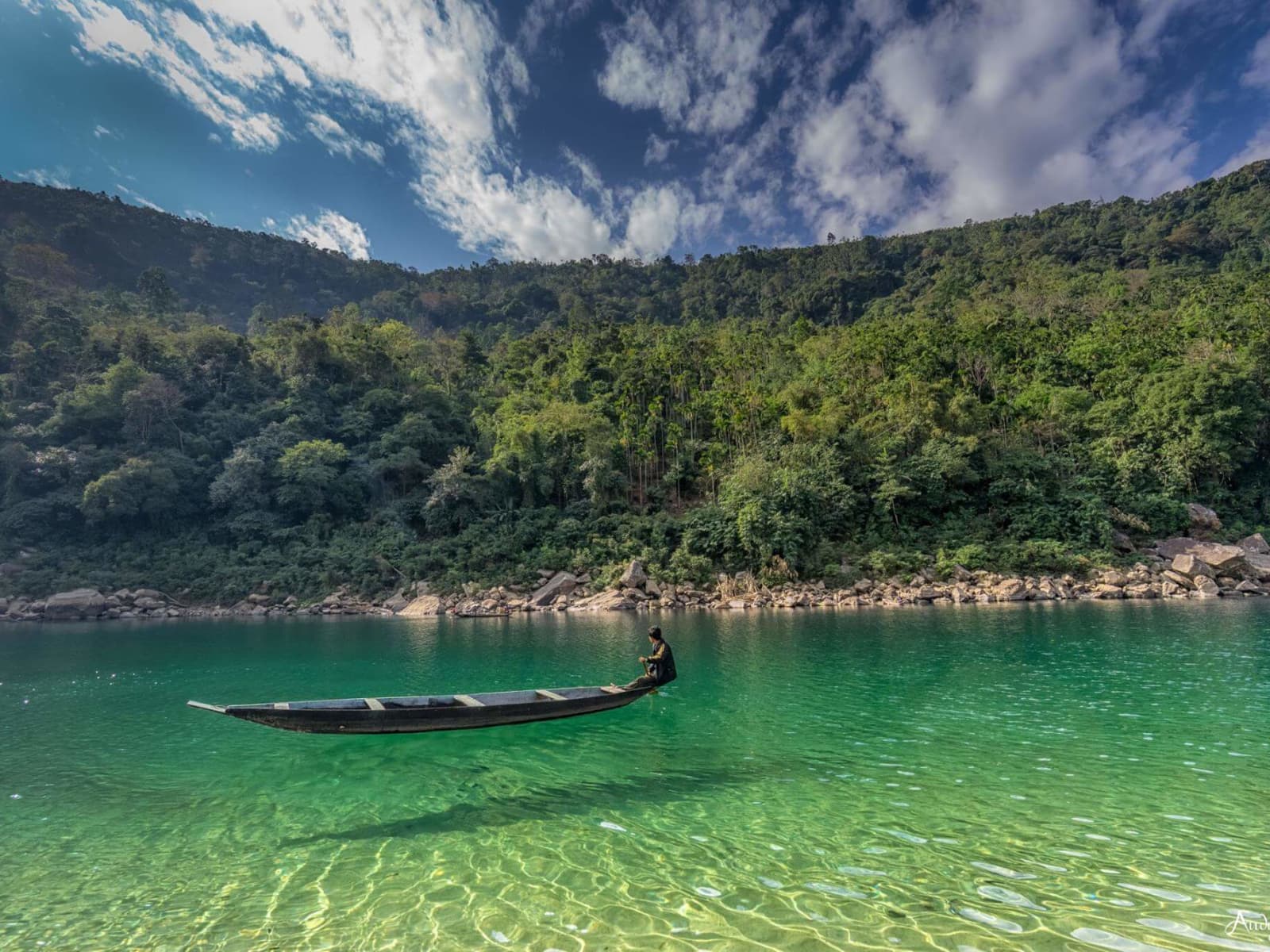
- No swimming or river bathing: While you may dip your feet into shallow edge pools during dry winter months, Wah Thyllong is an active village drinking water reservoir, not a swimming hole.
- No drone flights: Due to regional conservation policies and community privacy regulations, flying recreational drones is strictly prohibited without prior written permission from district authorities.
Getting to Riwai & Nearby Stops
Riwai is located in the Pynursla Block of East Khasi Hills and is easily reached via private cab or self-drive vehicle from major regional hubs:
- From Mawlynnong Village: 2.5 km (5 to 8 minutes by car, or a scenic 30-minute walk through betel nut and broomstick plantations).
- From Shillong: 80 km (2.5 to 3 hours) along NH206 (Shillong–Dawki Road) via Pynursla. The route traverses rolling tablelands before descending toward the southern sub-tropical slopes.
- From Dawki (Umngot River): 24 km (45 minutes) along well-paved border highways.
- From Cherrapunji (Sohra): 82 km (2.5 to 3 hours) via the scenic cross-plateau connector through Mawmluh and Pongtung.
- From Guwahati: 175 km (5 hours) via the Guwahati–Shillong Expressway (NH6) and NH206.
A classic one-day southern Meghalaya route pairs an early morning walk at the Riwai Living Root Bridge with a morning exploration of Mawlynnong Village, followed by afternoon boating on the transparent waters of the Umngot River in Dawki before returning to Shillong or Cherrapunji. For multi-day journeys, explore our curated Northeast India tour packages that integrate authentic local homestays across the Khasi Hills.
Insider Tips
- Arrive before 9:00 AM: Arriving early gives you the bridge almost to yourself in soft morning light before tour vehicles arrive from Shillong.
- Combine with Nohwet Viewpoint: Just across the Wah Thyllong trail on the Nohwet side lies a bamboo skywalk offering views across the Bangladesh plains.
- Wear sturdy walking shoes or hiking sandals: Avoid leather-soled shoes, flip-flops, or high heels, which struggle on damp river boulders and uneven stone steps.
- Carry small cash for parking and entry: Mobile network for UPI payments can be intermittent at the ticket kiosk near the trailhead.
- Mind Sunday village timings: The root bridge path remains open on Sundays, but Riwai handicraft stalls stay closed until 1:00 PM for morning church services.
- Support local bamboo artisans: Village stalls along the stone path sell handmade Khasi bamboo baskets, local wild honey, and freshly plucked organic pineapples.
7-Day Meghalaya Tour Package: Shillong, Cherrapunji, Dawki & Mawphlang
Highlands, Living Root Bridges & Clear Waters
Visitor & Booking Protocol
Permit & Entry Check
No special state permit required for Indian citizens. Keep government photo ID ready at entrance.
Tickets & Cash Protocol
Entry desk is managed on-site. Carry small cash denominations (₹20, ₹50, ₹100) for entry and parking.
Certified Guide Desk
Authorized village community guides can be hired at the entry registration desk. Certified guide rates range between ₹800–₹1,500 depending on circuit and trail duration.
Timing & Departure Cutoff
Arrive during early morning hours (08:00–10:30 AM). Mountain trails, caves, and viewpoints generally stop inbound entry by 15:30 to ensure safe return before mountain dark.
Safety & Rules
- • Maximum 5 to 10 persons on the bridge: Strictly follow the village committee capacity rule to preserve the living structural roots.
- • No high heels or spiked footwear: Shoes with sharp heels or cleats injure the living cambium bark of the Ficus elastica roots.
- • No carving or defacing root bark: Carving names or pulling root tendrils damages the vascular network of the ancient tree.
- • No soaps, detergents, or swimming: Wah Thyllong feeds downstream drinking water for neighboring villages; keep all chemicals out of the stream.
- • Drones strictly prohibited: Flying unmanned aerial vehicles (UAVs) without prior written permission from the district administration and village dorbar is banned.
- • Carry back all plastic and trash: Riwai maintains strict community cleanliness; use the woven bamboo conical bins (khoh) along the trail.
Frequently Asked Questions
More Places to Visit in Mawlynnong
Handpicked stops our drivers pass every week.


Best Time to Visit
Best time of day: Morning (07:30 AM – 09:30 AM) or late afternoon (03:30 PM – 04:30 PM)
Visitor Specs
Open daily year-round. On Sundays, the trail is open but village stalls observe church services until 1:00 PM.
How to Reach
Altitude & Terrain
500 m (1,640 ft)
7-Day Meghalaya Tour Package: Shillong, Cherrapunji, Dawki & Mawphlang
Highlands, Living Root Bridges & Clear Waters
Location
Lng: 91.897636
Plan Your Trip to Mawlynnong with Nezo
Combine Riwai Living Root Bridge with living tribal heritage, scenic mountain vistas, and handpicked local stays on a private guided journey.